|
DEFINITION
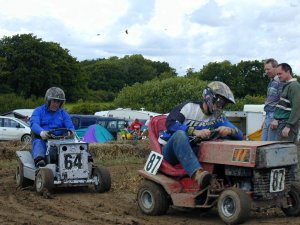
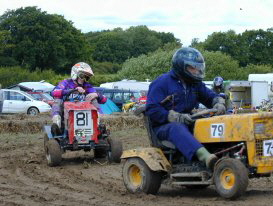
A Group 4 mower is a lawn tractor with chassis designed for 18hp or less, which has been designed to cut grass for domestic purposes. In standard form it will have the engine situated in front of the operator, covered by an obvious bonnet. A rotary blade cutting deck will be suspended under the chassis between the front and rear wheels. The original tyre sizes will have an obvious size difference front to rear offering a profile of a ‘baby’ agricultural tractor.
Any lawn tractor not found in the homologation list must be viewed and approved by the race committee prior to race preparation.
See General Rules and Regulations and remember, if it doesn’t say you can do it, you can’t do it.
ENGINES
1.The upper horsepower limit is 10hp (manufacturers rating) for a side valve engines and 7.5hp for overhead valve engines. Any domestic bonneted lawn tractor with a chassis designed to take up to a maximum of 18hp engine can be raced as specified in the Homologation list for that particular model
2.The engine must be retained in its original position and the crankshaft must be on the original axis.
3.Engines must remain standard and may not be modified or ‘blue printed’ in any way apart from the following:
•The exhaust pipe and silencer may be altered or changed.
•The governor may be removed or disconnected.
•No other alterations or modifications are allowed.
4.Should a rebore become necessary because of wear or damage, only the manufacturers standard or ‘oversize’ available piston and rings etc may be used as replacements.
5.The fuel for any engine must be ordinary pump fuel and be free from any performance / power increasing additives.
6.Should the entrant be in any doubt about the legality of his/her engine, they must consult the race committee.
DRIVE
1.The original type of drive i.e. belts, chains, gears or whatever, must be retained. Pulleys, gears etc, may be changed for bigger or smaller ones to alter ratios. If the drive was originally through a chain case on the side of the mower, it must continue to be through the chain case on the original side.
2.A Gearbox may only be used if originally fitted, then it must be standard and to the original specification. No variable transmissions i.e. no torque converters or variable pulleys are permitted.
3.Lawn mower tyres and wheels must be used. Cleated or Quad tyres are forbidden. Particular attention should be paid to the fixing of wheels to the axles.
SAFETY
1.Mowers must be fitted with an automatic throttle closing device, which will work whenever the driver’s hand or foot leaves the throttle control. Two independent throttle closing devices to be used, e.g. two springs.
2.An ignition cut out, which will work under any circumstances should the driver loose contact with the mower. A noose around the driver’s wrist is not acceptable. The cut out connection must be positively fastened both to the driver and the cut out and must not extend further than 3 feet.
3.No sharp edges or protrusions are allowed.
4.A braking system must be fitted.
5.Any part of the exhaust pipe that could be used as a grab handle must be wrapped or guarded.
CHASSIS and BODYWORK
1.The overall chassis profile may not be altered from standard. By chassis we mean the basic chassis specification, i.e. body, bonnet, fairings, mudguards etc, as produced by the manufacturer. By profile we mean lengths, widths, heights, and visual appearances etc. The only exceptions are as follows:
•Discreet out of sight strengthening to the chassis
•Discreet transmission accommodation i.e. if a large drive pulley will not fit in the chassis without cutting out the metal, then this may be done, but only as much as necessary.
2.The bodywork above the chassis line may not be altered from standard and must remain in its original position.
3.Seats may be lowered. The method of lowering the seat will be specified in the Homologation list. This may only be achieved by raising the axle up into the chassis or by removing a minimal amount of metal directly under the seat.
4.Seats may be modified or changed but the backrest may not be higher than the driver’s shoulder blades.
5.Safety guards must be fitted to prevent interlocking wheels. The cutter decks may be retained if they adequately prevent interlocking and are securely fitted. However, these guards must fill 80% of the open gap between the front and rear wheels, and protrude no further than the outer edge of the rear tyres. The top edge of the guards should be sited slightly above the centre line of the axles, and be 3 inches in depth with a flat outer face.
6.Suspension of any kind, springs, shock absorbers, may not be fitted to any mower unless fitted as original equipment and in this case must all remain exactly as standard.
7.Cutting blades must be removed.
HOMOLOGATION
It is the responsibility of members to contact the race committee to agree details, dimensions, and evidence of eligibility of any lawn mower type not currently homologated, prior to its acceptance.
|